
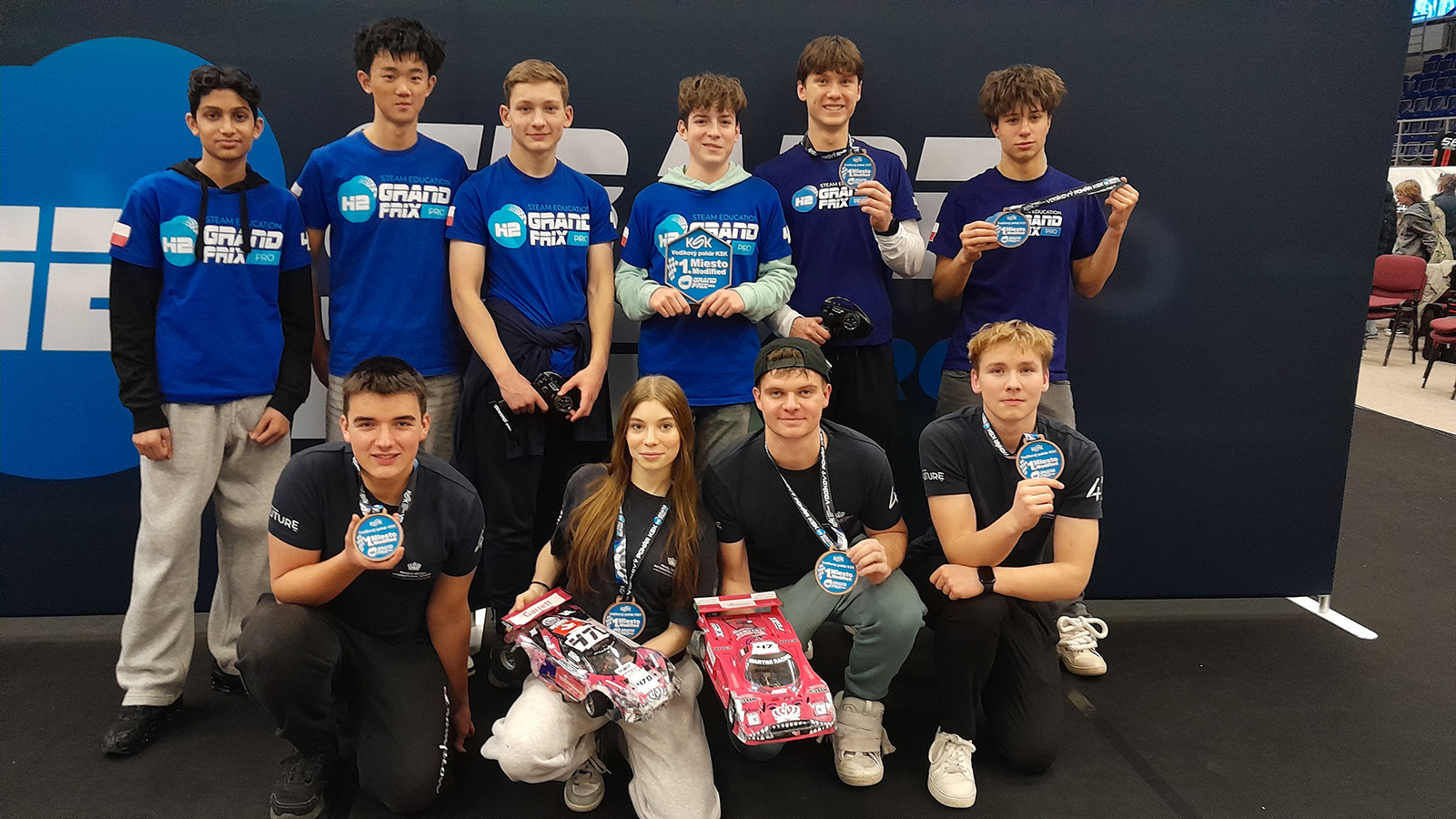
At PBIS, STEAM clubs are more than an extension of classroom learning. They are spaces where curiosity can turn into real projects. In an environment that connects science, technology, engineering, arts, and mathematics, students are encouraged to experiment, collaborate, and take ownership of ambitious ideas. One of these projects is the Hydrogen Car initiative.
Here, students design, build, and test their own hydrogen-powered vehicles before racing them in international competitions. This January, a new team HYDRO PBIS JUNIORS stepped into this world. Alongside the more experienced HYDRO PBIS senior team, they participated in the Košice Hydrogen Cup 2026 for the first time. They arrived as newcomers. Yet in the Green Category for modified cars, they achieved an impressive 5th place out of more than ten teams. The result mattered. But the journey behind it mattered even more.
Three members of the junior team Wojciech, Herbie, and Mikhail came to the project through different paths. Herbie has been at PBIS since Year 3. His first technical project appeared in Year 9, when he built an RC hovercraft. A teacher noticed the project and introduced him to the Hydro Car club. Mikhail has been at the school since Year 4. Electronics had not been a major for him before, but the club opened a new field to explore. He first noticed the project during an IGCSE subject evening when he saw older students testing the hydrogen car. Wojciech joined the school this year. He had experimented with various small projects and clubs before, but this was the first time he committed to one long-term project with real technical depth.
The team has five members, each with a clearly defined role. Herbie works primarily as a mechanic. Wojciech focuses on mechanical work and electronics, designing a custom printed circuit board that collects performance data from the car. Mikhail is the team’s driver and also develops the software that processes the data and helps optimize the car’s performance. Their work naturally overlaps hardware and software evolve together.
Their first race also brought several challenges.
During the competition, the team had to deal with multiple technical issues. The hydrogen fuel cell was already quite old and had to be replaced mid-race. At one point a wheel came loose and had to be repaired quickly in the pit area. At the start of the race, the team also discovered a hydrogen leak, which they managed to fix with equipment borrowed from other teams. Despite these complications, they returned to the track and finished the race. For the students, these moments became some of the most valuable learning . “From the driver’s position, the pressure is intense,” says Mikhail. “Once the car leaves the pits, everything is in our hands. You learn very quickly how to deal with stress and make decisions under pressure.”
Herbie highlights the technical lessons: “We learned a lot about the setup of the car — for example how tight the differential should be and how small adjustments affect performance.” Wojciech remembers the fuel cell replacement most clearly: “It was a stressful moment, but we handled it well.”
The environment of the school plays a key role in the project. The Hydro Car club is largely student-led. Students experiment, design solutions, and search for knowledge independently. Teachers and mentors support the process, while the senior team shares experience and advice. Senior students often the junior team improve their designs and sometimes pass down older components that can be modified and tested.
Motivation within the team comes from several directions. For Mikhail, the project offers the chance to learn skills that go far beyond typical classroom activities. Herbie admits that competition also plays an important role many other schools specialize in building vehicles and have years of experience, which makes the challenge even more exciting. For Wojciech, the greatest value lies in the learning potential. The project introduced him to technical areas he might never have explored otherwise.
The experience is already influencing their future plans. Herbie is considering studying mechanical engineering and hopes to continue similar projects at his next school. Wojciech always planned to pursue engineering, but the project introduced him to elecelectrical engineering, which he now finds particularly interesting. Mikhail is exploring the possibility of combining engineering and physics, and the club is helping him clarify which direction he wants to take.
The team is also thinking about future projects. One idea currently being explored is the creation of a drone club, potentially leading to drone racing competitions in the future. When asked what advice they would give to new students, the team’s message is simple. “We need more people,” says Wojciech. “Dedicated people who are willing to learn and build something together.” Mikhail adds that previous experience is not necessary. “What matters most is commitment. The rest can be learned.”
The Hydrogen Car project at PBIS shows how curiosity in the classroom can evolve into real engineering experience.
And sometimes, the path toward future careers begins exactly this way with one project, one team, and one race.