
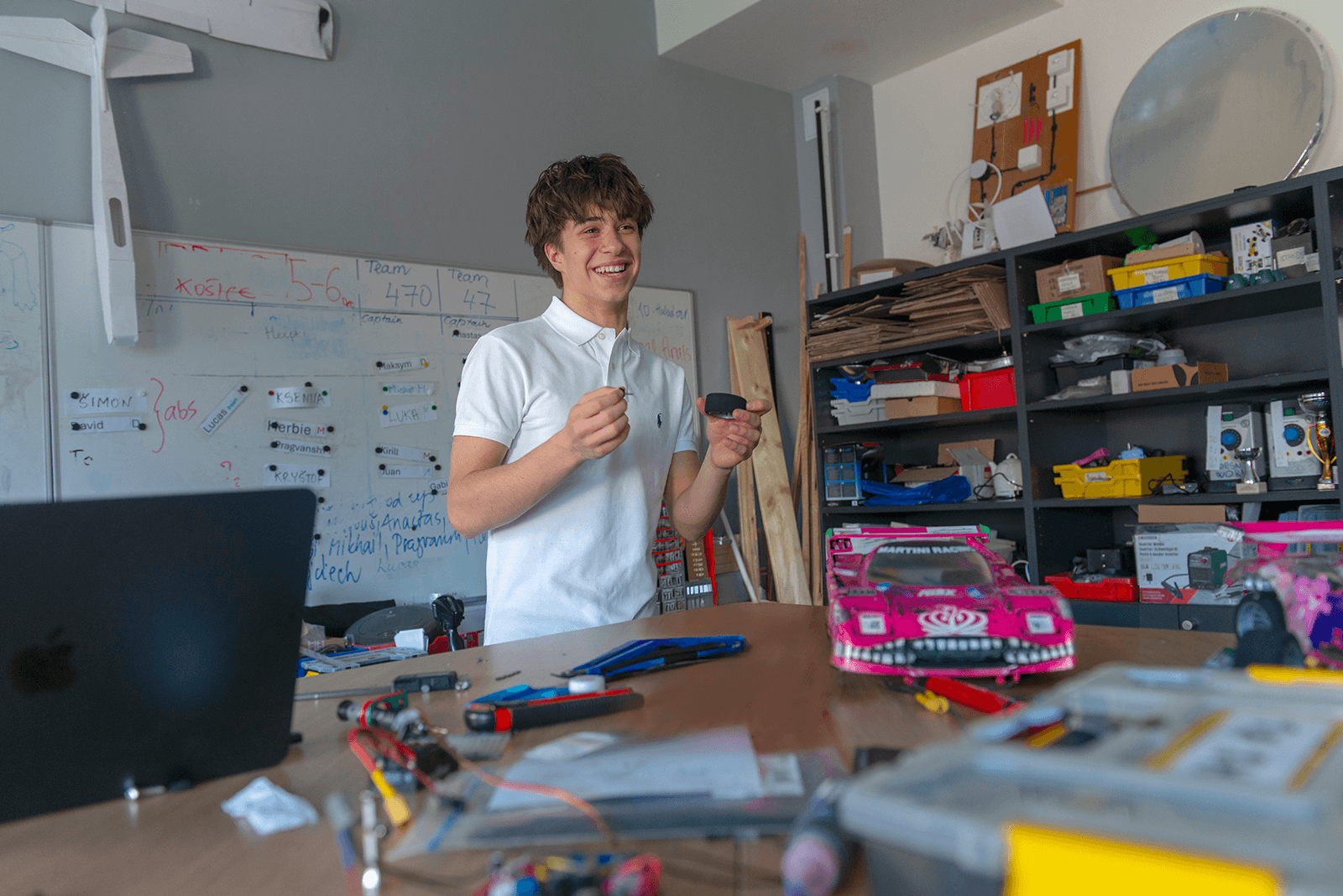
Anastas has been a part of PBIS since 1st grade. Today, as a 12th grader, he is known for his technical commitment and leadership skills as part of the school’s hydrogen car project. But his journey to engineering didn’t start with a clear plan.
It started almost by accident. About three years ago, Anastas joined the STEAM club simply because I needed to pick an extracurricular activity. What started as a reluctant decision quickly turned into one of the most remarkable engineering journeys led by students at PBIS. Today, he plays a central role in the development of the PBIS hydrogen car – redesigning mechanical components, experimenting with new technologies and helping to lead a team that recently won 1st place in the modified car category at the Košice Hydrogen Cup 2026.
Although Anastas has been involved in PBIS since the beginning of his school career, he first encountered the hydrogen car project in the 10th grade. His physics teacher introduced him to the club and suggested that he give it a try. At the time, Anastas had very little knowledge about hydrogen-powered vehicles. “I thought, why not?” he recalls. “I need to join a club anyway.” He had always enjoyed cars especially Formula 1 but their construction and engineering were something completely new to him. When he joined the club, the previous team had just graduated and left the car at home. The message he received was simple: Here’s the car. Do whatever you want with it. “I didn’t know how it worked,” he says. “I took everything apart and then told myself I didn’t know how to put it back together.”
The project was in limbo for a while. Then the deadline came. A week before the race, Anastas’s teacher told him that the car had to be ready in time for the race. With little experience but great determination, he began putting the parts back together. Somehow, the car worked. During that race, however, Anastas noticed something that completely his approach. The team was falling behind. “I’m very competitive,” he explains. “When I saw that we were behind the others, I knew we had to improve.” From that point on, the project became much more than just a club activity. It became a connection.
Much of Anastas’ technical knowledge was built through and self-study. He studied how race cars are set up for different tracks and discovered that each track required a different configuration for optimal performance. Over time, he developed strong skills in mechanics, chassis design, and performance tuning. He also began working with 3D design and 3D printing software, eventually buying his own 3D printer to create custom components for the car. “I’m most proud of the mechanical side of the car, the chassis,” he says. Not every experiment worked. One of his most ambitious attempts was to design his own electronic control system for a hydrogen fuel cell. It failed miserably. “I burned it a few times,” he admits. “I even blew it up once. Electronics is definitely not my strong suit.” But even that became part of the learning process.
As the project grew, Anastas realized that one person couldn’t improve the car. He began to organize the team more systematically, creating different areas of responsibility within the club. This structure of students is largely focused on specific tasks while also collaborating on the development of the car. Trust in the team has become one of the most valuable outcomes. “A project works best when people are genuinely interested and committed,” they explain.
As the hydrogen car project developed, the school began to provide more and more support. Teachers and school administrators helped with funding, materials, and logistical support. One of the strongest sources of encouragement was the school staff, who believed in the long-term potential of the project. “They always believed we could improve,” says Anastas. “I did when we finished last.” What makes PBIS unique, he says, is the degree of independence the students are given. Many of the competitions feature other teams from specialized automotive schools, where teachers manage the technical work. At PBIS, the approach is different. Teachers coordinate logistics and the project, but the design, experimentation, and technical decisions remain largely in the hands of the students. This freedom allows creativity and innovation to flourish.
During the competitions, Anastas also began to learn from teams from all over Europe. Czech teams are among the strongest in the world and provided valuable insights into chassis design with optimal performance. A Slovak team helped him better understand the hydrogen fuel cell system. Beyond student teams, he also began building connections with industry professionals. He reached out to companies internationally, forming contacts with specialists who helped manufacture parts for the car, including custom carbon-fiber chassis components produced using CNC milling technology. These connections significantly advanced the team’s technical capabilities.
One of Anastas’s most memorable experiences came during a race hosted at PBIS earlier this year.For the first time, he saw one of the leading teams usually dominant in competitions begin to worry that PBIS might overtake them. Watching the car perform exactly as designed perfectly balanced in corners and operating at its limits was deeply rewarding. “It behaved exactly how I expected it to,” he recalls. Moments like this confirmed that years of experimentation and persistence had paid off.
Before joining the Hydrogen Car club, Anastas had not seriously considered what he wanted to study at university. Now, his direction is much clearer. He hopes to pursue engineering at a university that participates in Formula Student, an international competition where students design and build full-scale racing cars. In many ways, the Hydrogen Car project introduced him to that possibility.
Looking back, Anastas believes the Hydrogen Car club at PBIS offers much more than technical experience. For students willing to invest time and energy, it provides an opportunity to explore engineering, develop leadership skills, and build connections far beyond the classroom. “It’s a place where dedication really matters,” he says.
At PBIS, projects like the Hydrogen Car club show how curiosity, persistence, and the freedom to experiment can turn a simple extracurricular activity into a defining educational experience.